After an Uber or Lyft crash, the first question is usually “Whose insurance pays?” The answer depends on what the driver’s app was doing at the moment of impact, and rideshare companies don’t make that easy to find out. As Burbank Uber accident lawyers, Glotzer & Leib LLP digs into the app data, the policies, and the facts so the right insurer answers for your injuries.
Our headquarters is on North Hollywood Way, the same road that carries rideshare traffic to Hollywood Burbank Airport. Call 747-241-8288 for a free consultation, 24/7.
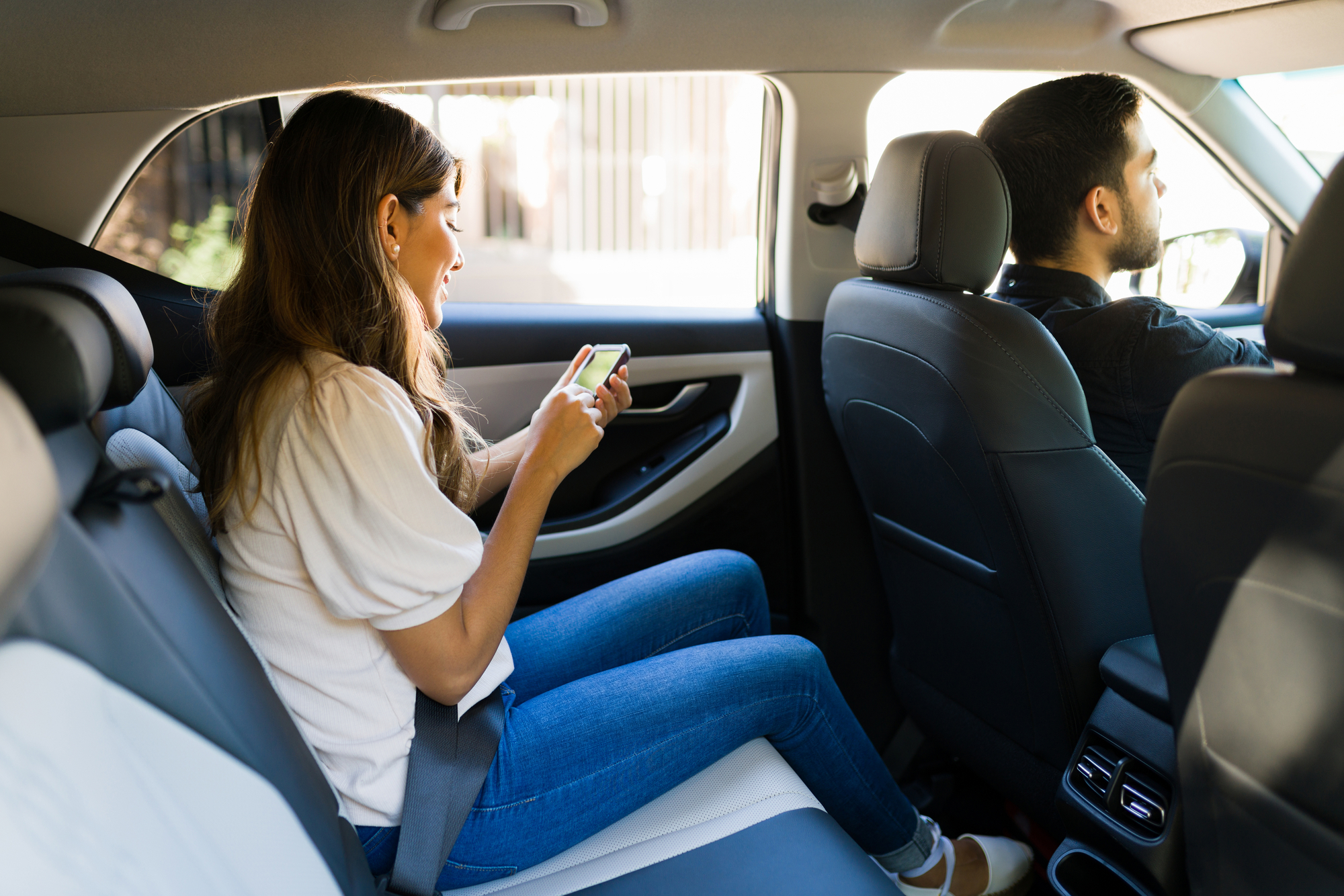
Side view of an attractive latin woman sitting on the car back seat and using a ride share app on her smartphone
The paying insurer depends on the rideshare driver’s status at the time of the crash. California’s Public Utilities Code Section 5433 sets minimum coverage that Uber, Lyft, and other transportation network companies must carry at each stage of a trip.
Here’s how coverage generally works for crashes on or after January 1, 2026:
| Driver’s app status | Primary coverage | What it means for you |
|---|---|---|
| App off | Driver’s personal auto policy only | The claim works like any car accident. California’s minimum is $30,000 per person and $60,000 per accident for bodily injury. |
| App on, waiting for a request | Rideshare company policy: $50,000 per person, $100,000 per incident, $30,000 property damage, plus at least $200,000 in excess coverage | This is the stage insurers dispute most. Proving the app was on can open up much more coverage. |
| Ride accepted, driving to pickup | $1,000,000 in primary liability coverage | The high-limit policy applies even though no passenger is in the car yet. |
| Passenger on board | $1,000,000 in primary liability, plus uninsured and underinsured motorist coverage of $60,000 per person and $300,000 per incident | Passengers are covered whether their driver or another driver caused the crash. |
The $1 million coverage most people have heard about doesn’t apply until the driver accepts a ride. When a driver claims to be “between rides,” the app’s trip records often become the most important evidence in the case, and we move early to secure them.
Rideshare claims pit injured people against billion-dollar companies and their insurers. You need a team that knows how these claims work and won’t back down.
Every case depends on its facts, and we’ll give you a straight assessment of yours. Call 747-241-8288 to talk with our team.
Hollywood Burbank Airport, still officially named Bob Hope Airport, sends a constant flow of rideshare cars up and down Hollywood Way. Drivers circle for pickups, stop suddenly to confirm a rider, and pull over in traffic when the app redirects them.
That pattern creates familiar crash types:
App-directed driving splits a driver’s attention between the phone and the road. When that distraction causes a crash, the trip data, messages, and timestamps can help prove it.
Rideshare accidents involve three very different kinds of claims. We handle each one differently.
Passengers are rarely at fault. If your driver caused the crash, the rideshare company’s $1 million policy generally applies, and if another driver caused it, you may claim against that driver’s insurance and the rideshare uninsured or underinsured motorist coverage.
If you were in another car, on a bike, or on foot, the available coverage depends on the driver’s app status. The same crash can be worth very different amounts depending on whether the app was off, on and waiting, or en route to a pickup.
Drivers injured by another motorist can pursue the other motorist’s insurer. When the at-fault driver has little or no coverage, uninsured or underinsured motorist coverage, and the occupational accident insurance app companies carry for drivers may also come into play.
Often not directly, because California treats most app-based drivers as independent contractors under Proposition 22. That status limits claims that try to hold the company responsible for a driver’s mistakes simply because the driver works on its platform.
It doesn’t erase the company’s insurance obligations under Section 5433, which apply regardless of how drivers are classified. In some cases, a rideshare company may also face claims tied to its own conduct, and we look for those facts in every case.
It protects people in a rideshare vehicle when the at-fault driver has no insurance or insufficient coverage. For crashes on or after January 1, 2026, California requires this coverage at $60,000 per person and $300,000 per incident while a passenger is in the car.
That’s a big drop from the $1 million required before 2026, and serious injuries can exceed it quickly. Your own auto policy’s uninsured or underinsured motorist coverage may add another layer, so we review every policy that could apply.
Rideshare passengers usually ride in the back seat, often looking at a phone or luggage instead of the road. That means they rarely brace for impact, and the injuries can be worse than the damage to the car suggests.
The injuries we see most often include:
Travelers flying out of Burbank sometimes skip the doctor to make a flight or get home. If you can, get checked the same day or as soon as you land, and keep the records, since a gap in care is one of the first things an insurer will point to.
Both Uber and Lyft let riders and drivers report a crash through the app. Reporting it creates a record tied to your trip, and that record helps show which coverage period applied.
Keep a few things in mind when you report:
An in-app report isn’t the same as an insurance claim. The injury claim itself usually goes to the insurer that covers the rideshare company, and once you have a lawyer, we handle those conversations for you.
California follows pure comparative negligence, adopted by the California Supreme Court in Li v. Yellow Cab Co. (1975). If you share some blame, your compensation is reduced by your percentage of fault rather than wiped out.
Most injury lawsuits must be filed within two years under Code of Civil Procedure Section 335.1. If a public entity was involved, such as a city vehicle or a dangerous road, a claim must usually be presented within six months.
Rideshare cases leave a digital trail, but that trail sits in the company’s hands. We act quickly to request and preserve it.
If you were a passenger, save your trip receipt and take screenshots right away. Those details help us prove which coverage period applies.
These are the questions we hear most often from people hurt in Burbank rideshare crashes.
If you were a passenger and your Uber driver caused the crash, the rideshare company’s commercial policy generally pays. California requires at least $1 million in liability coverage while a passenger is in the car.
If the app was on while the driver waited for a request, the company’s lower-limit policy applies, with excess coverage above it. If the app was off, only the driver’s personal policy applies. The company’s trip data shows which is true.
Sometimes. Because California treats most drivers as independent contractors, direct claims usually require evidence of the company’s own wrongdoing. Even without one, the company’s required insurance may still cover your injuries.
Every injured passenger may have a claim, and they may all draw from the same policy limits. That makes it important to present your claim early and document your injuries fully.
Yes. Section 5433 applies to every transportation network company in California, so the same coverage periods and minimum limits apply to Lyft, Uber, and similar services.
Yes, in most cases. California requires every passenger to buckle up, so an insurer may argue that not wearing a seat belt made your injuries worse. Under pure comparative negligence, that argument can reduce your recovery, but the insurer has to prove it, and it doesn’t cancel the claim against the driver who caused the crash.
The older coverage rules generally apply. Before 2026, California required $1 million in uninsured and underinsured motorist coverage while a passenger was in the car, rather than the current $60,000 per person and $300,000 per incident. The two-year filing deadline still applies, so an older crash may need action soon.

Rideshare companies and their insurers have teams working to limit what they pay. Glotzer & Leib LLP will fight to hold the right insurer accountable for your injuries.
We’re available 24/7, and your consultation is free. Call 747-241-8288 to talk with a Burbank Uber and Lyft accident lawyer today.
GLOTZER & LEIB, LLP 1023 N Hollywood Way Ste 202, Burbank, CA 91505


“Mr. Glotzer represented me after I was involved in a car accident. I was badly injured,but the insurance company refused to offer me a reasonable settlement. I decided to find an attorney and decided to hire Josh.
His law firm did a great job on my case. They were very responsive to all my questions and obtained a great resolution for me. I received way more money than was originally offered. I would recommend their firm to friends and family.”
“Mr. Josh Glotzer is a great attorney. Over the last 15 years he has helped me on a number of cases with professionalism, and more importantly a positive outcome in my favor. I have referred him to a number of friends and colleagues, all of which have been equally as happy with his legal representation. I trust him and confident in legal ability. I highly recommend his law firm.”
“Don’t try to deal with insurance companies on your own. They strung me along for almost two years before I gave the case to Glotzer & Leib. Josh and his team quickly obtained a settlement that netted me many times what the insurance company was offering. Thank You!”
“My wife was in a car accident last year and Josh did an amazing job representing her. It’s very refreshing to see someone in his profession that actually cares and puts his clients first. He’s the best in the business and I feel so fortunate that I was referred to him. Keep up the great work and thanks for everything you did for my family!”
“I was in a rear end car accident last year and hired Mr. Glotzer’s office. It wasn’t a big case but their office helped me with my property damage claim and did a good job resolving the injury portion of the case as well.”